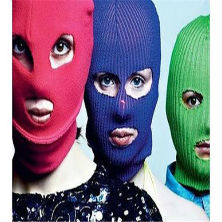
Pussy Riot is a Russian feminist punk-rock collective that stages politically provocative impromptu performances in Moscow, on subjects such as the status of women in Russia, and, most recently, against the election campaign of Prime Minister Vladimir Putin for President of Russia.
In March 2012, three women from the band were arrested and charged with hooliganism; their trial began in late July. The women have attracted considerable sympathy both within Russia and internationally, due to allegations of harsh treatment while they have been in custody, and the threat of a possible seven year jail sentence. The trial has been compared by some foreign observers to a show trial.
Performances and influencesTheir usual costume is brightly-colored dresses and tights, even in bitterly cold weather, with their faces masked by balaclavas, both while performing and giving interviews, for which they always use pseudonyms. The collective is made up of about 10 performers, and about 15 people who handle the technical work of shooting and editing their videos, which are posted to the Internet. The group cites punk rock and Oi! bands Angelic Upstarts, Cockney Rejects, Sham 69, Era and The 4-Skins as their most important musical inspiration.
The band also cite American punk rock band Bikini Kill and the Riot grrrl movement of the 1990s as an inspiration. They have said: “What we have in common is impudence, politically loaded lyrics, the importance of feminist discourse and a non-standard female image”.
Church protest
Interior of the Cathedral of Christ the SaviourOn February 21, 2012, as a part of a protest movement against re-election of Vladimir Putin, three women from the group came to the Cathedral of Christ the Saviour of the Russian Orthodox Church in Moscow, crossed themselves and began to perform a song. After less than one minute, they were escorted outside the building by guards. The film of the performance was later used to create a video clip for the song.
In the song, the group asked the “Theotokos” (Mother of God, i.e. the Virgin Mary) (rus. Bogoroditsa) to “chase Putin away”. The song also mentioned Russian Patriarch Kirill I of Moscow as someone who believes in Putin rather than in God.
Arrest and prosecutionOn March 3 Maria Alyokhina and Nadezhda Tolokonnikova, two alleged members of Pussy Riot, were arrested by Russian authorities and accused of “hooliganism”. Both women at first denied being members of the group and started a hunger strike in protest against being held in jail away from their young children until their case came to trial in April. On March 16 another woman, Ekaterina Samutsevitch, who had earlier been questioned as a witness in this case, was similarly arrested and charged.
On June 4, the group was presented with formal charges on an indictment 2,800 pages long. On July 4 they were suddenly informed that they would have to finish preparing their defense by July 9. They announced a hunger strike in response, saying that two working days was inadequate time for preparations for a trial defense. On July 21 the court extended their pre-trial detention by another six months.
The three detained members of Pussy Riot are recognized as political prisoners by the Union of Solidarity with Political Prisoners (SPP). Amnesty International named them prisoners of conscience due to “the severity of the response of the Russian authorities”.
Some prominently expressed opinions in Russia have been much harsher. Speaking at a liturgy in Moscow’s Deposition of the Robe Church on March 21, the Patriarch of Moscow and All Russia Kirill I condemned Pussy Riot’s actions as “blasphemous” saying that the “Devil has laughed at all of us … We have no future if we allow mocking in front of great shrines, and if some see such mocking as some sort of valour, as an expression of political protest, as an acceptable action or a harmless joke.” Meanwhile, several thousand Orthodox and Catholic believers, people of other religions and atheists signed a petition to Patriarch Kirill, begging the head of the Russian Orthodox Church to stand up for the women.Singer Alla Pugachyova appealed on the women’s behalf, stating that they should be ordered to perform community service rather than be imprisoned. According to BBC correspondent Daniel Sandford, “Their treatment has caused deep disquiet among many Russians, who feel the women are – to coin a phrase from the 1967 trial of members of the Rolling Stones – butterflies being broken on a wheel.”
By late June 2012, growing disquiet over the trio’s detention without setting a trial date and concern over what was regarded as excessive and arbitrary treatment, led to the drawing up of an open letter. It was signed by leading oppositional figures as well as director Fyodor Bondarchuk, a supporter of Putin, and actors Chulpan Khamatova and Yevgeny Mironov, both of whom had appeared in videos for Putin’s re-election campaign. Pro-Kremlin Nikita Mikhalkov, head of the Russian Cinematographers’ Union, stated in an interview that he would gladly sign an open letter against them.
In July 2012, sociologist Alek D. Epstein published a compilation of artistic works by various Russian artists entitled “Art on the barricades: Pussy Riot, the Bus Exhibit and the protest art-activism” in support of the trio.
The trial of the three women started in Moscow’s Khamovniki, or Khamovichesky, District Court on July 30. Charged with “premeditated hooliganism performed by organized group of people motivated by religious hatred or hostility”, they face possible sentences of up to seven years imprisonment. In early July, a poll conducted in Moscow found that half of the respondents oppose the trial while 36 percent support it; the rest being undecided. The defendants pleaded not guilty, insisting that they had not meant their protest to be offensive. On July 31, The Financial Times published an editorial saying the women had become “an international cause célèbre” due to the harsh treatment they have received.
International support
The accused have received support from foreign musicians such as Kate Nash, Red Hot Chilli Peppers, Sting, Jarvis Cocker, Pete Townshend,Peaches, Madonna, and Yoko Ono.[26][27][28] Also, 121 members of the German parliament, the Bundestag have sent a letter to the Russian Ambassador to Germany, Vladimir Grinin, in support of the three jailed members. The letter from the Bundestag referred to proceedings against the women as being disproportionate and draconian.