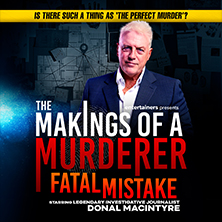
Donal MacIntyre’s “The Makings of a Murderer: Fatal Mistake” is a true-crime stage production built around the extraordinary cases of murderers who came dangerously close to escaping justice. Presented by award-winning investigative journalist and broadcaster Donal MacIntyre, the show explores the investigations behind crimes in which killers believed they had carefully concealed their actions, only for a seemingly insignificant mistake to expose them.
MacIntyre is known for his work as an investigative journalist and broadcaster, particularly for reporting that has taken him into difficult and often dangerous environments. In Fatal Mistake, that investigative background shapes the way the stories are presented. Rather than simply recounting murders, MacIntyre focuses on the process by which investigators gradually reconstruct what happened and identify the weaknesses in a killer’s attempt to avoid detection.
The central idea of the production is that even apparently carefully planned crimes can unravel because of one overlooked detail. The cases examined involve murderers who lied to investigators, attempted to destroy evidence, constructed false alibis or otherwise tried to distance themselves from their crimes. Some remained free for considerable periods, creating the impression that their plans had succeeded.
Yet the title Fatal Mistake refers to the moment when those plans begin to collapse. A tiny forensic trace, an overlooked witness, a piece of CCTV footage, a telephone call, a contradiction in someone's story or a sudden change in behaviour can provide investigators with the breakthrough they need. These apparently minor details can become crucial pieces of evidence when examined alongside the wider investigation.
MacIntyre’s role is not simply that of a narrator. The production places him at the centre of the storytelling, using his investigative experience to examine how police and forensic teams follow leads and gradually build a case. The audience is taken through the uncertainty surrounding each investigation before seeing how apparently unrelated details can eventually connect.
The show also explores the tension between a killer’s confidence and the reality of criminal investigation. Those responsible may believe they have anticipated every possibility, but investigations can continue long after the initial crime. Witnesses can remember important information, technology can reveal movements, forensic techniques can uncover traces and inconsistencies can become increasingly difficult to explain.
At its heart, The Makings of a Murderer: Fatal Mistake is therefore about the fragile nature of a supposed perfect crime. Its stories examine not only the actions of murderers, but also the persistence of investigators and the importance of evidence that might initially appear insignificant. MacIntyre presents these real-life cases as investigations filled with uncertainty, unexpected discoveries and dramatic turning points.
The production ultimately asks how close these killers really came to escaping justice and what finally exposed them. By concentrating on the mistakes that shattered carefully constructed deceptions, MacIntyre turns each case into an exploration of investigation, evidence and human fallibility. The result is a true-crime presentation centred on the moments when seemingly successful attempts to conceal murder finally begin to unravel.